

Are we exhibiting at trade shows – and what happens if we don’t?
Why should companies prioritise exhibiting at trade shows in B2B when cost pressures are rising and every investment is under scrutiny? This article explores why trade shows remain a strategic growth channel—and what’s at stake if your business is not present at the right moment.
As the economy slows, organisations tend to become cautious. Investments are postponed, decisions delayed, and new initiatives assessed more critically. Uncertainty is visible everywhere—from fluctuating forecasts to geopolitical instability—forcing businesses to prioritise carefully.
In this environment, marketing budgets are often among the first to be questioned. They are visible costs, and their impact is not always immediately reflected in financial results. As a result, exhibiting at trade shows is frequently one of the first activities to be cut.
The decision is understandable—but strategically significant.
The real question is not: “How much can we save?” but rather:
“What is the impact if we are not present?”
Companies that dare to pause and consider this question begin to see trade shows from a different perspective: what happens if we are not present at the exact moment when the market is finding its direction and customers are comparing their options?
Exhibiting at trade shows is a strategic touchpoint
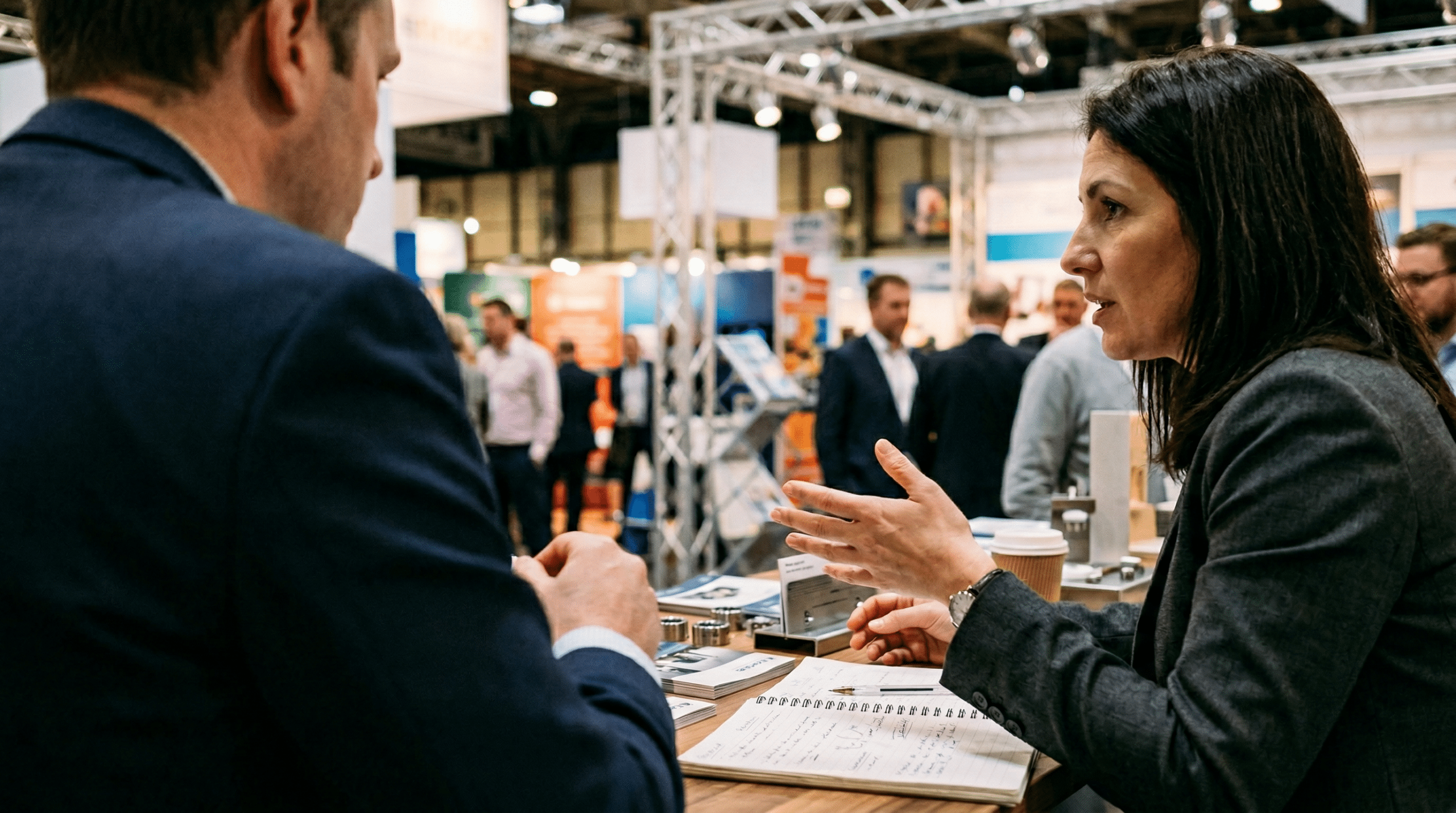
Trade shows are still too often viewed as standalone cost items that either deliver immediate ROI or do not. In reality, they are one of the few environments where marketing, sales, brand, products, and customers meet—live and in person.
In B2B, this remains exceptionally valuable.
A key insight from discussions with our clients is this:
The value of exhibiting at trade shows does not come from presence alone, but from how well participation aligns with business strategy.
Janne Haikonen, Sales and Marketing Director at Kaso Oy, describes this shift clearly:
“We were on the verge of significantly reducing our trade show participation. Traditional events were no longer delivering the results we expected. But when we reassessed participation from a strategic perspective, we realised that some key target groups could only be reached through specific industry events.”
This realisation changed their approach. By selecting trade shows based on strategic relevance, participation became focused, purposeful, and clearly tied to business outcomes.

The same thinking is increasingly visible across organisations that see trade shows as a core part of relationship-building and the commercial process.

Iiris Kujala, Marketing and Communications Manager at Visy Oy, explains:
“For us, trade shows play a key role in strategic marketing and sales. They are a recognised channel for networking with prospects, partners, and industry peers. Many conversations started at events later turn into business opportunities.
Trade shows enable brand visibility, experience, and interaction in a way that leaves a lasting impression—something difficult to achieve through other marketing channels.”
Especially when solutions are complex and investments significant, customers want to understand who they are working with—not just what they are buying. Face-to-face interaction remains critical.
Being present at trade shows also sends a subtle but powerful message:
we are committed to our industry, our customers, and the future.
Not all trade shows are equal—and they shouldn’t be
Exhibiting at trade shows is not an end in itself. Event selection must be deliberate and business-driven.
According to Haikonen, the key insight was recognising the importance of relevance:
“We realised that certain people simply cannot be reached anywhere else than at trade shows and events. It was about identifying the right and relevant ones for us. Once we aligned participation with strategy, results improved significantly—and our attitude towards trade shows changed quickly.”
At Kaso, participation was focused on events where key decision-makers were present. Trade shows became a powerful channel for building networks and opening meaningful conversations.
This highlights an important principle:
the value of trade shows comes from relevance—not volume.
When objectives are clear, trade shows become a strategic tool—not a one-off activity. Companies must define their role:
Are we building visibility, sharing thought leadership, or primarily listening and learning?
Each role can be valuable—when it serves a clear purpose.
Leads and relationships: quality over quantity
The best interactions do not always lead to immediate deals—but they move relationships forward.
They build trust, clarify needs, and strengthen the sense that both parties are working towards shared goals.
According to Haikonen, trade shows are one of the few channels where certain high-value connections can be made—connections that are difficult to establish through digital marketing or outbound sales.
At leading international events, decision-makers and experts are present in ways that cannot be replicated through online channels or public databases.
“When a company is present where key industry conversations take place, it creates a direct connection to the right level of decision-making—or to those who drive things forward in practice.”
What happens if we are not exhibiting at trade shows?
This is the critical—and often uncomfortable—question.
What does the market think if you are not present when conversations are happening?
Does silence signal strategic prioritisation—or withdrawal?
More importantly:
who fills the space you leave behind?
Who are your customers speaking to instead?
Who hears their questions, uncertainties, and plans?
Who builds the trust that future decisions are based on?
Trade shows are not where all deals are closed immediately.
They are where tomorrow begins—one conversation at a time.
The real question is not whether—but why
Exhibiting at trade shows is a strategic decision, even if executed through marketing.
It signals to the market:
- what role your company aims to play
- how seriously you take customer relationships
- whether you are willing to invest in growth—even in uncertain times
A trade show decision is not just a cost decision.
It is a statement about where and how your company chooses to be present when future partnerships are formed.
Text: Sanna Jokinen, Sales Manager
Are you present in the right conversations?
We help you identify the events where your presence truly matters. From strategy to execution, we design trade show participation that supports your business and creates meaningful connections with the right people.